


We are currently in the midst of a unilateral, indefinite extension of the… extension of the ceasefire by the U.S., accompanied by a naval blockade of Iranian ports. Iran has closed the Strait of Hormuz to any ships it chooses. The resumption of negotiations is constantly being announced and constantly postponed.
Everything indicates that the US-Israel attack on Iran has entered a phase that resembles a battle of attrition, with the Strait of Hormuz serving as the instrument of destruction! We have reached this point after the US’s reckless plans to topple the Iranian regime by decapitating the Iranian leadership and deployment of a terrifying military force from the air failed, and while a ground operation—albeit limited in time and scope—was temporarily set aside following the losses incurred during the operation in Isfahan.
Russia’s Warning to Iran
Just one day after the ceasefire took effect, the Russian Security Council warned Iran’s leadership that the United States could use the time allotted for negotiations to prepare a ground operation. The buildup of U.S. military forces in the region, and specifically the coincidence of the arrival of the third aircraft carrier, the “Bush,” with the expiration (before it was extended) of the ceasefire (April 20), served as evidence of this. Beyond the coincidences, one wonders whether this accumulated firepower (three aircraft carriers with their escorts, as well as the helicopter carrier “Tripoli”), which is already being used as a lever of pressure against Iran,could be used in some other way (and exactly how?) so that the U.S. can secure an agreement that will provide them with a dignified exit?
The Strait of Hormuz and the American “chokepoint”
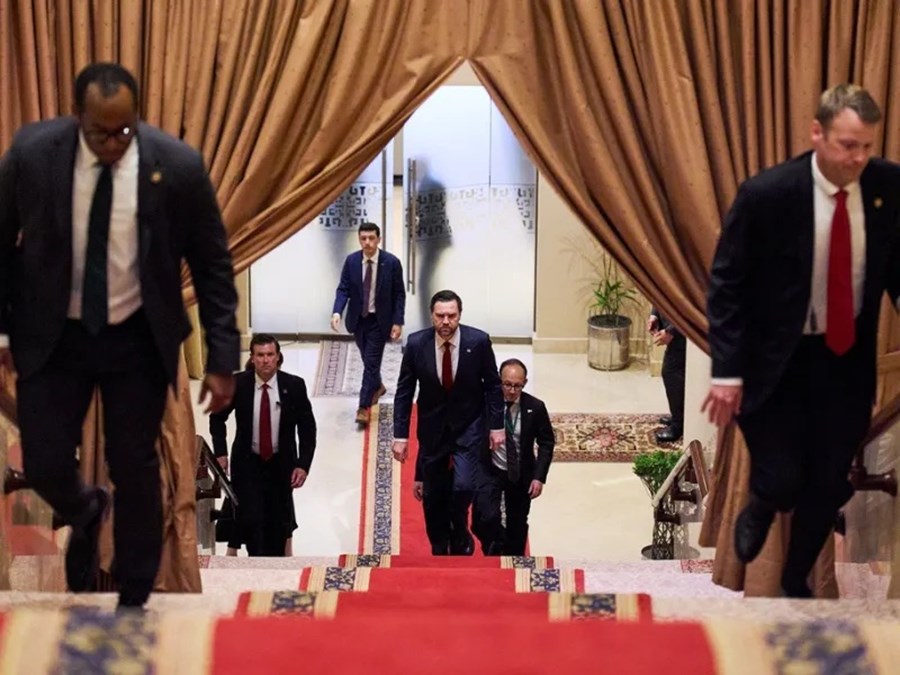
Vance’s abrupt withdrawal from the two-day talks on April 11–12—which the Iranian negotiating team described as a surprise— was allegedly justified by Iran’s unwillingness to “give” the U.S. what it wants, primarily regarding the nuclear program. Indeed, the Trump administration has recently structured its demands primarily around the Iranian nuclear program (“hand over the enriched uranium to the U.S.,” something Iran considers unacceptable) and secondarily on the issue of the Strait of Hormuz. Further down the agenda are the missile program, as well as Iran’s relationship with the forces of the so called “axis of resistance.”
Through this focus, the U.S. aims to extricate itself from the strategic impasse at the lowest possible cost. As Trump himself admitted, the “exit” of American imperialism must absolutely include a deal “on Iran’s nuclear program” that is better than the one in 2015. If this does not happen, let us imagine the cost in terms of the U.S.’s prestige and credibility, as well as the repercussions on the balance of power within the American ruling class. Then, the “bill” for Trump’s policy toward Iran, from the 2017 withdrawal from the Iran Nuclear Deal (JCPOA) to last year’s bombings of Iran’s nuclear facilities, and of course and above all, to the current warmongering, would be a heavy one for both the Trump administration and U.S. imperialism. Add the following to the “bill”: The widening of the Euro-Atlantic rift, with European imperialists in open disagreement with U.S. policy, meeting in London and making decisions regarding their—always post-war! – contribution to “the protection of freedom of navigation.” The deep concerns of the American establishment regarding the consequences of the depletion of missile stocks on the major front in Ukraine or on those that could open (Taiwan). The dissatisfaction of the U.S.’s Asian allies (South Korea, Japan, Australia) with the redeployment of defense systems from the Indo-Pacific to the Middle East. Does the awkward jab—from the otherwise brash Trump—at China, claiming that a Chinese ship seized by the U.S. was carrying weapons for Iran, highlight the U.S.’s “struggles”? Does the third assassination attempt against Trump in a row also highlight these difficulties on a larger scale?
The naval blockade, therefore, concerns the entire negotiation. In fact, we could say that regarding the issue of the Strait of Hormuz, Iran has de facto changed the status of the Strait. Thus, specifically regarding the Strait, the U.S. is at a disadvantage, with the most it could gain being the (how likely?) restoration of the Strait to its previous status. You wouldn’t exactly call that a success…
In any case, so far the U.S. has avoided the risk of the blockade turning into a fiasco or even backfiring. Of course, for Western analysts, it remains unclear whether this is a move of desperation or, on the contrary, a calculated move—albeit out of necessity—as Ilan Berman, vice president of the American Foreign Policy Council (AFPC), one of the most influential think tanks in American foreign policy. According to Berman’s analysis, the U.S. has the ability “to turn Iran’s greatest geographical advantage into a vulnerability, and that is what they are doing now.” Such a move “would achieve two critical objectives: it would deprive the Iranian regime of its most vital source of revenue and make every Gulf oil-dependent state a stakeholder in containing the Iranian regime.” This would occur at a time when the economic and social situation in Iran has deteriorated and Iran has become much more vulnerable to the pressure of a disruption in its energy exports. Thus, it would force the Iranian leadership to choose: either “real concessions regarding their nuclear program and their behavior in the region, or economic strangulation.”
However, beyond theoretical models, what really matters is the actual impact of the U.S. naval blockade. And on this point, opinions and evidence are divided. Some Western media outlets and analysts claim that “the naval blockade appears to be working: ships are stopping, shipments are frozen, and traffic has dropped dramatically… no new shipments have been recorded at Iranian ports since the blockade began.” On the other hand, the BBC notes that “monitoring shipping in the region is inherently difficult—many ships turn off their transponders or falsify their data, meaning that some activity remains ‘invisible.’” Furthermore, Iran already has alternative methods… such as storing oil in floating storage tanks or transporting it via third parties.” Lloyd’s reports that since the blockade was implemented, 26 ships have passed through, 11 of which are Iranian. The Tanker Trackers service notes that, based on its data, Iran’s crude oil exports to China and India remain unchanged.
Issues of Iranian Unity
The Iranian leadership’s reversal within a 24-hour period regarding the Strait of Hormuz gave the U.S. administration and Western media an opportunity to speak of division and conflict between the political leadership (the president, the foreign minister, and the speaker of parliament) and the Revolutionary Guards, to the extent that the speaker of parliament was forced to issue the statement “we are all Iranians.” At first glance, it appears there is a divergence within the leadership regarding the methods, scope, and nature of a compromise. On the other hand, so far this division does not appear to have the magnitude that the Trump administration attributes to it for the purposes of exploitation and psychological warfare.
What we can say with greater certainty is that the Iranian leadership would also like to see
an agreement reached. Iran may have largely thwarted the objectives of the U.S. (and Israel). Control of the Strait of Hormuz and the impact on the global economy may still be a
strong card for the Iranian leadership. It may be true, as noted in an article by P.P. in “Kathimerini,” that “the rate at which its arsenals are being depleted is lower than that of the Americans.” However, as the same article points out, Iranian territory has suffered extensive damage, with costs estimated at $270 billion. It is notably stated that “125,000 buildings have been damaged, including 339 healthcare facilities, 31 universities, 857 schools, and 20,000 industrial and manufacturing facilities.” It would therefore be unreasonable for the leadership of a country that has suffered an unprovoked attack with such far-reaching consequences not to seek an agreement that would enable it to rebuild. Despite their differences, at least so far, the Iranian leadership is not considering the possibility of handing over uranium to the U.S. It will not give the U.S. what it did not take by force. And this, based on what we have written about the U.S., makes the possibility of a compromise more difficult. Parts of the Iranian leadership appear to be discussing the handover of some or all of the uranium to Russia (which has “offered” to take it for some time now), but it remains to be seen whether this will bring the two sides (the US and Iran) closer or complicate matters. Perhaps in the coming days we will see the broader results of the Iranian Foreign Minister’s trip to Russia in practice.
In conclusion, there are serious questions about what will follow the ceasefire. Or to put it another way: it remains to be seen what might happen between a ceasefire and the effort to reach an agreement, which in any case does not seem easy.
Published in issue 1006 of the Proletarian Flag (May 2, 2026)